Research PhaseFor researchers and clinicians (experimental)
Executive Function Assessment
An experimental Executive Function Assessment platform with a live three-domain research battery. Available to try online. Not clinically validated or diagnostic.
Every Habib Labs product is created research-first, with an evidence-based approach.
Digital EF research needs a unified experimental pathway
Existing measures do not always provide a unified pathway for remote administration, research exports, and experimental multi-domain task development. Habib Labs is building toward that architecture carefully, without claiming clinical readiness ahead of evidence.
Solution
An initial three-domain research battery
The Habib Labs Executive Function Assessment currently centers on three scientifically motivated tasks (working memory, response inhibition, and cognitive flexibility), with research-first session structure and planned pathways for clinician and public modes. Clinical validation is not claimed before the evidence exists.
Instruments
Assessments & stimuli
Visuospatial working memory
Grid Memory Task (GMT)
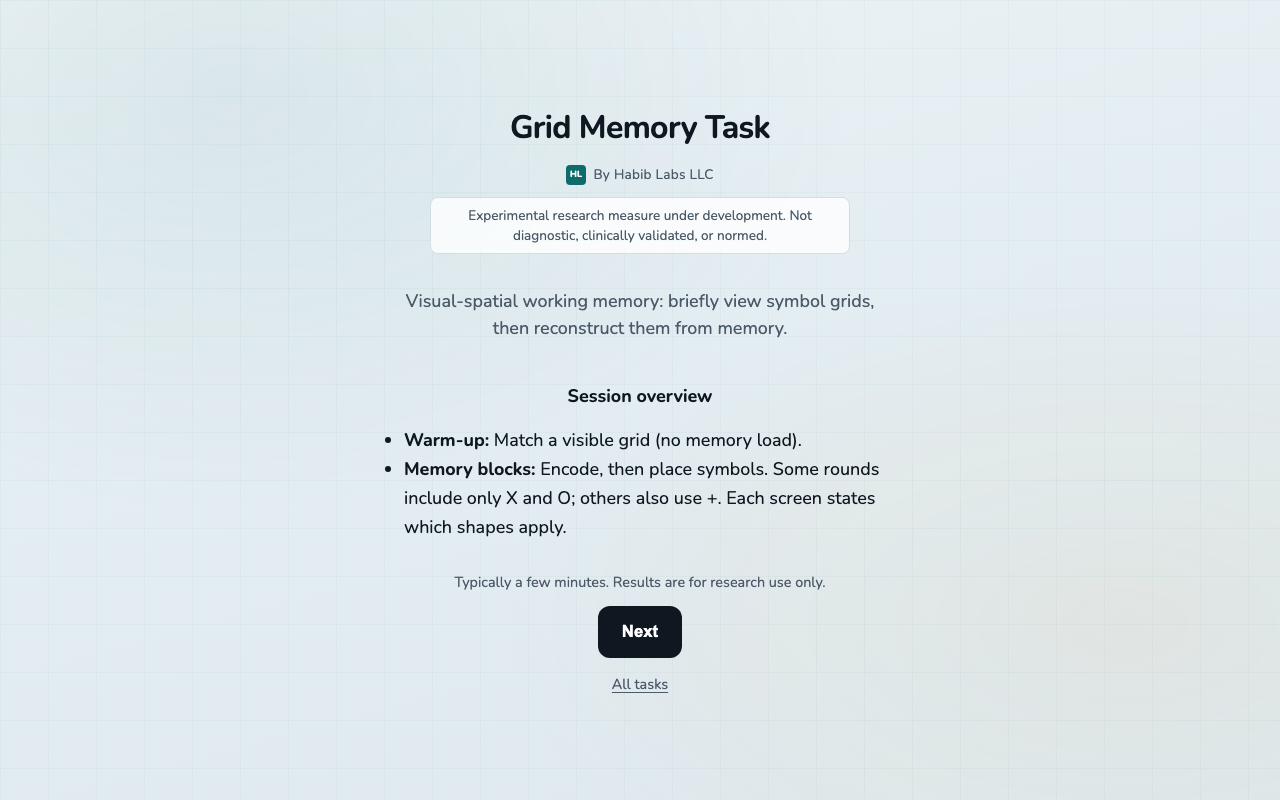
Participants briefly see symbols on a 4×4 grid, then reconstruct the layout from memory. Conditions vary load with distractors and delay so researchers can estimate span and interference costs under different demands.
Stimulus examples
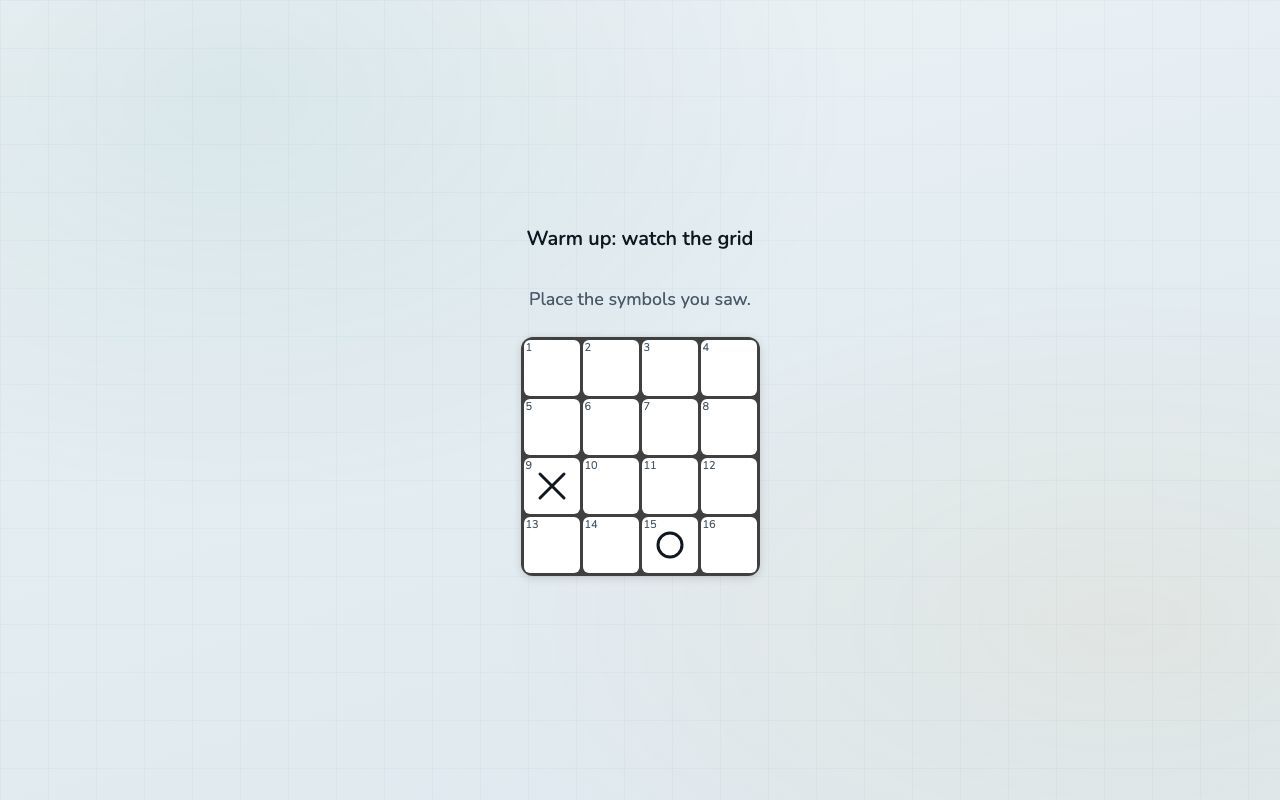
Encoding grid (X / O). A 4×4 grid briefly displays target symbols (X and O). After the grid disappears, the participant places those symbols back into an empty grid from a palette.
Distractor Plus (+). In ignore- and remember-distractor conditions, Plus signs appear with targets. Instructions tell the participant either to ignore Plus or to remember where Plus appeared.
Delay fixation. In the delay condition, a short fixation pause (“Brief pause”) sits between encoding and reconstruction to tax maintenance over time.
Example GMT encoding display: symbols on a 4×4 grid
Experimental research measure of visuospatial working memory. Not diagnostic, clinically validated, or normed.
Response inhibition
Response Inhibition Task (Signal Gate)
A go / no-go style task: respond quickly to allowed signals, and withhold when a stop cue appears. Color is always paired with shape and texture so performance does not depend on color alone.
Stimulus examples
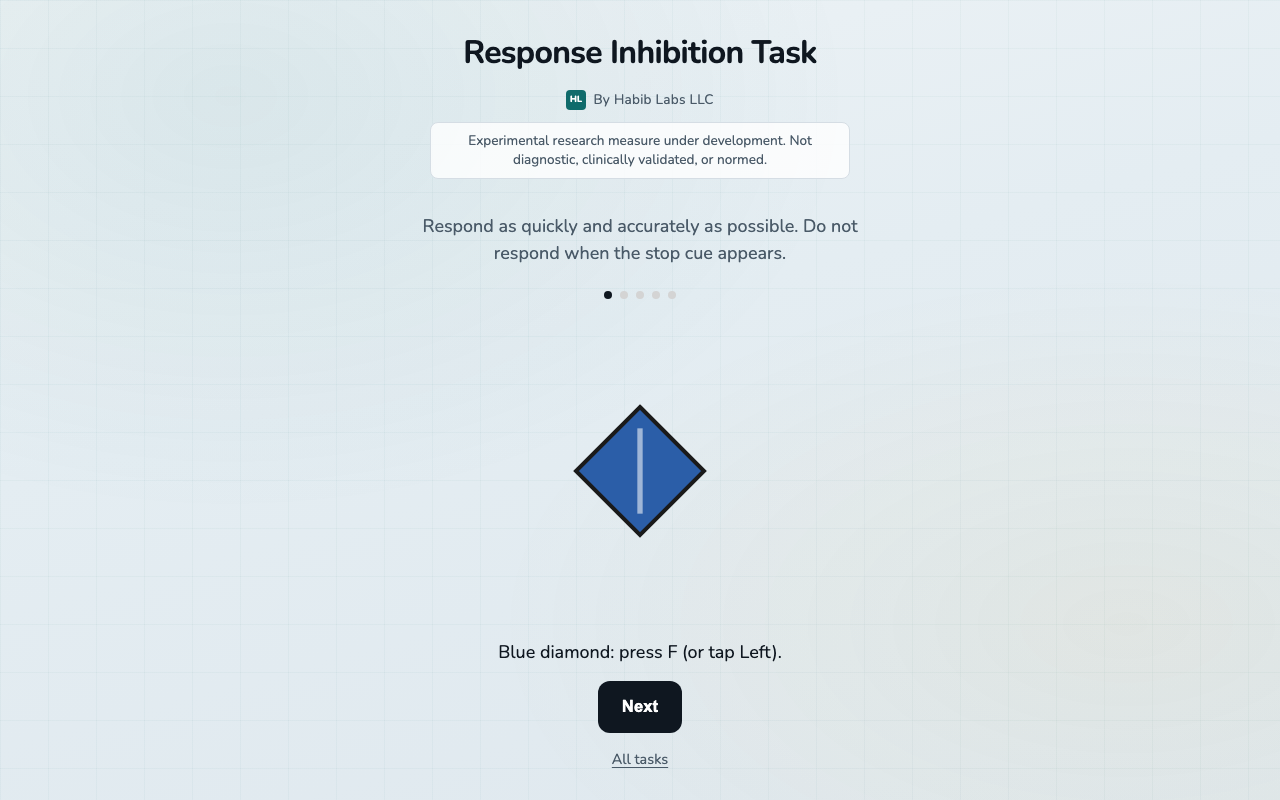
Go-A: blue diamond. Blue diamond with a vertical texture stripe. Respond on the mapped side (e.g. Left).
Go-B: amber hexagon. Amber hexagon with hatch texture. Respond on the opposite mapped side (e.g. Right).
No-Go: stop ring. A dark stop ring with slash overlays the figure. Withhold any response.
Interference: reverse frame. A double contextual frame can reverse the Go-A / Go-B mapping, raising inhibitory demand without turning the task into set-shifting.
Example Signal Gate stimulus: go / no-go visual cues
Experimental research measure of response inhibition. Not an ADHD diagnostic, IQ, or attention label.
Cognitive flexibility / set-shifting
Cognitive Flexibility Task (Rule Shift)
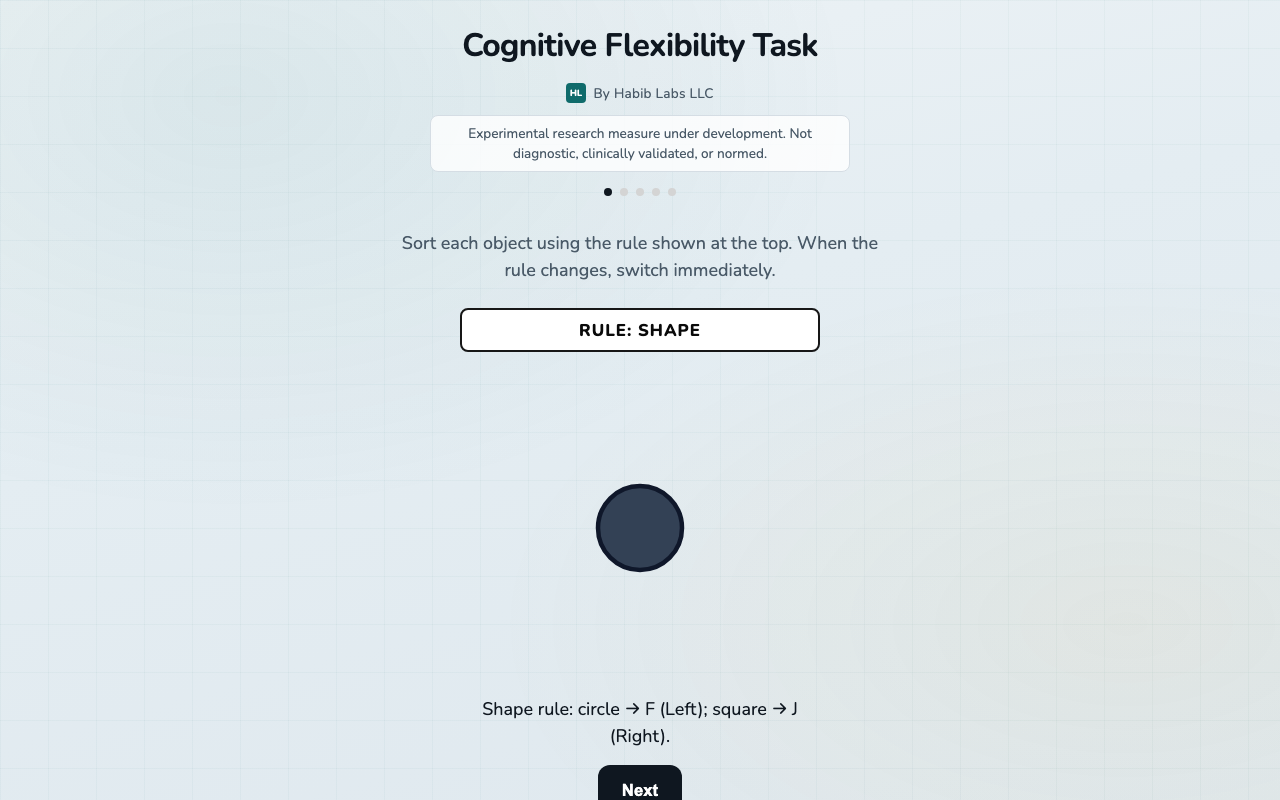
Participants classify multi-feature objects under a cued rule (shape, pattern, or number). When the cue changes, they must abandon the previous rule and apply the new one, measuring set-shifting, not primary inhibition or working memory.
Stimulus examples
Shape. Objects are circles or squares; the cue may ask the participant to sort by shape.
Pattern. Fill is solid or striped; the cue may ask the participant to sort by pattern.
Number. One or two objects appear; the cue may ask the participant to sort by count.
Rule cue banner. A cue banner names the active rule (e.g. Shape). Left/Right responses stay fixed; only the sorting rule changes across blocks.
Example Rule Shift stimulus: multi-feature object with rule cue
Experimental research measure of set-shifting. Not diagnostic, validated, or normed in current phases.
Workflow
How it works
1
Domains assessed
Working memory, inhibitory control, and cognitive flexibility through structured tasks (including Grid Memory, Response Inhibition, and Cognitive Flexibility instruments).
2
Adaptive administration
Architecture planned for adaptive testing pathways as psychometric evidence matures.
3
Gamified experience
Engaging task presentation options designed to sustain attention without sacrificing construct clarity.
4
Clinician mode
Administration pathways intended for supervised clinical and training contexts (under development).
5
Research mode
Export-friendly, research-ready session structure for studies and pilots.
6
Public mode
A future pathway for broader access. Clearly separated from clinical interpretation.
7
Remote administration
Designed with remote delivery constraints in mind as the platform matures.
8
Normative database
Long-term initiative to build large-scale norms. Not available for clinical cutoffs today.
Features
Capabilities
Initial three-domain battery
Working memory, inhibition, and set-shifting in one experimental platform.
Research-ready exports
Session structures intended for analysis and pilot work.
Mode architecture
Research pathways available; clinician and public modes on the roadmap.
Honest experimental labeling
Not diagnostic, validated, or normed in current phases.
Remote-ready design intent
Built with future remote administration in mind.
Validation roadmap
Pilots, psychometrics, and norms planned before clinical claims.
Security
Research ethics & claims discipline
Experimental instruments under development. Habib Labs will not claim diagnostic validity or clinical norms ahead of evidence.
Explicit experimental labeling in-product
No diagnostic cutoffs in current phases
Research exports without overstated interpretation
Clinician mode will require privacy-oriented controls as PHI pathways expand
Roadmap
Where this is going
Now
Task battery & pilots
Stabilize instruments and run structured pilot work.
Next
Psychometrics & validation studies
Reliability, validity, and study protocols.
Later
Norms & multi-mode scale
Normative database, remote admin, public mode.
Screenshots
Interface
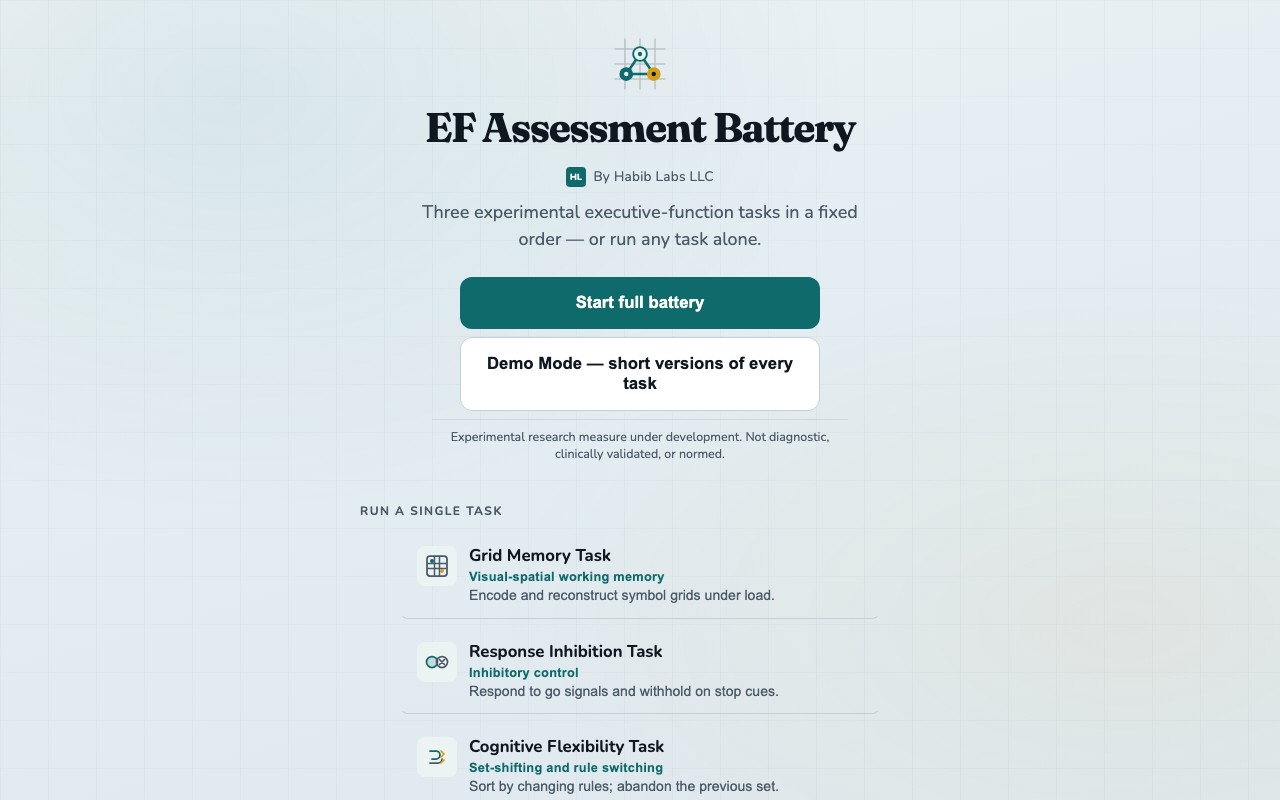
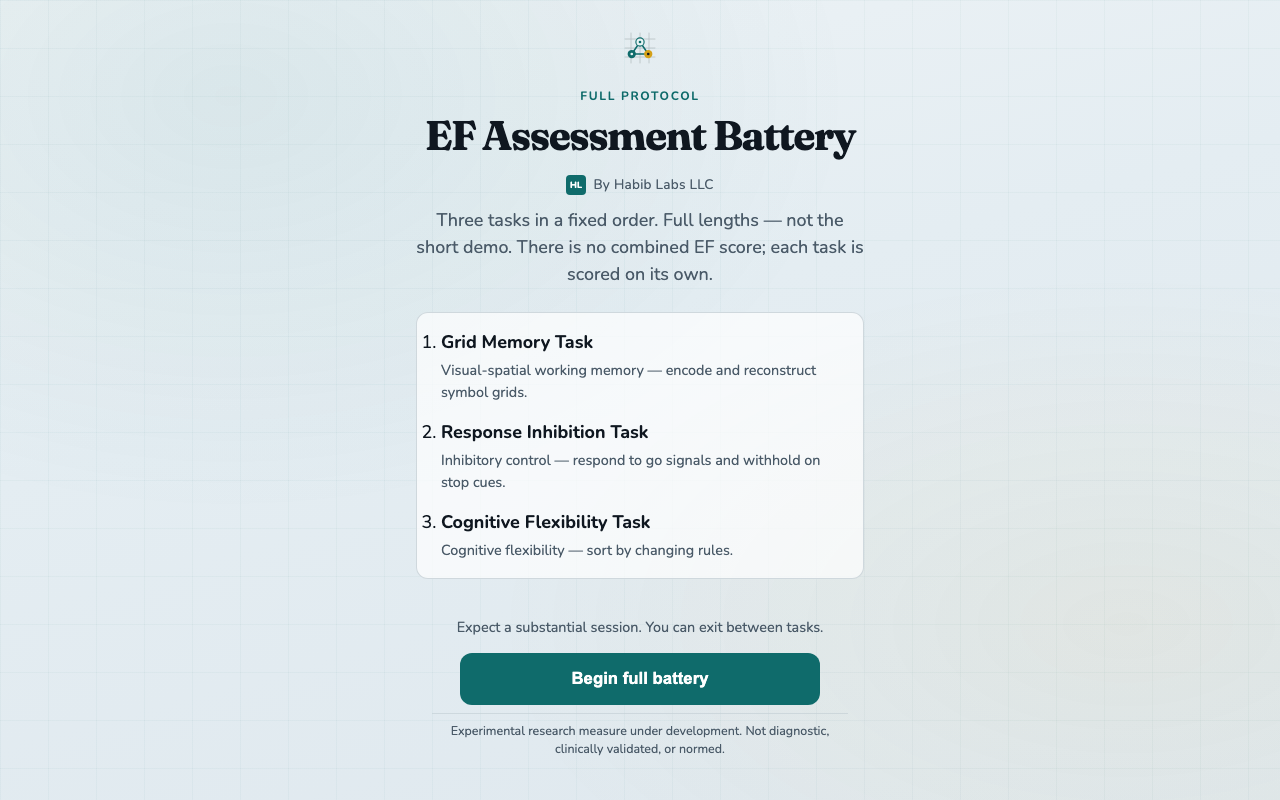
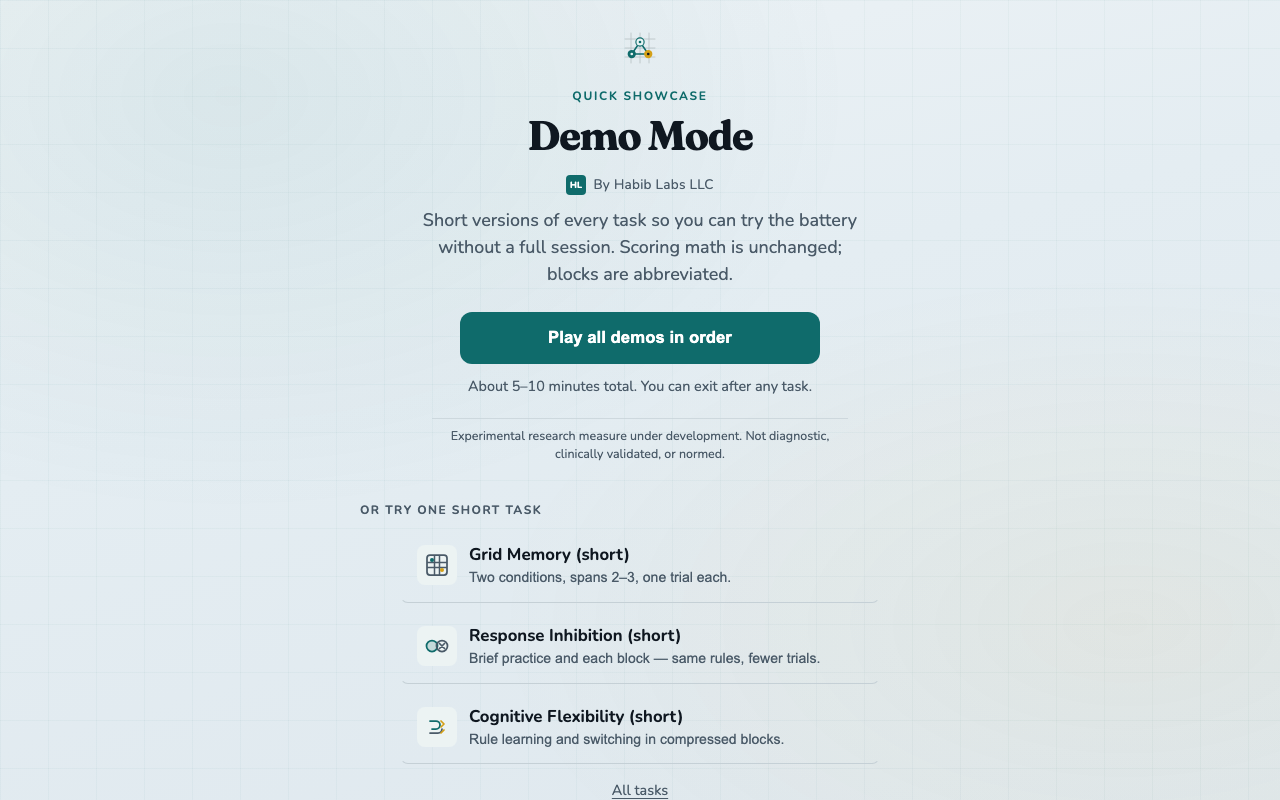
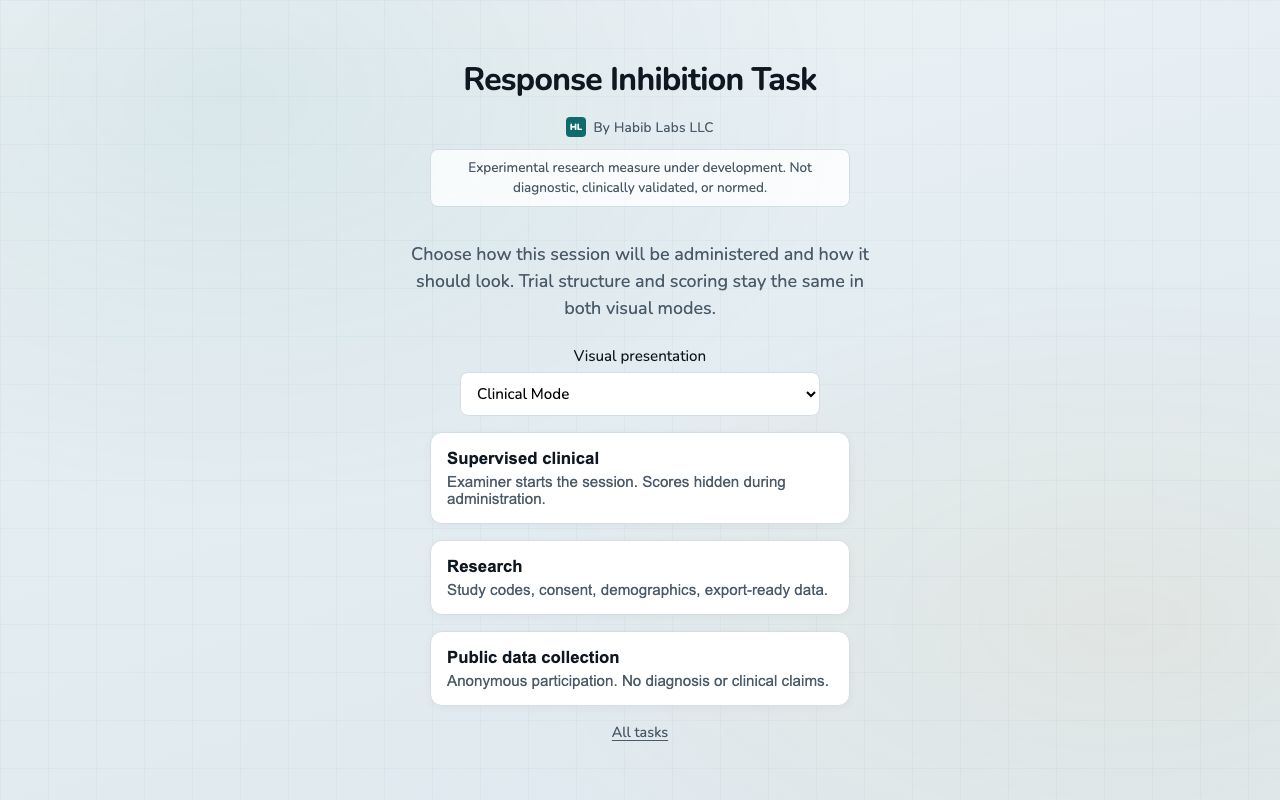
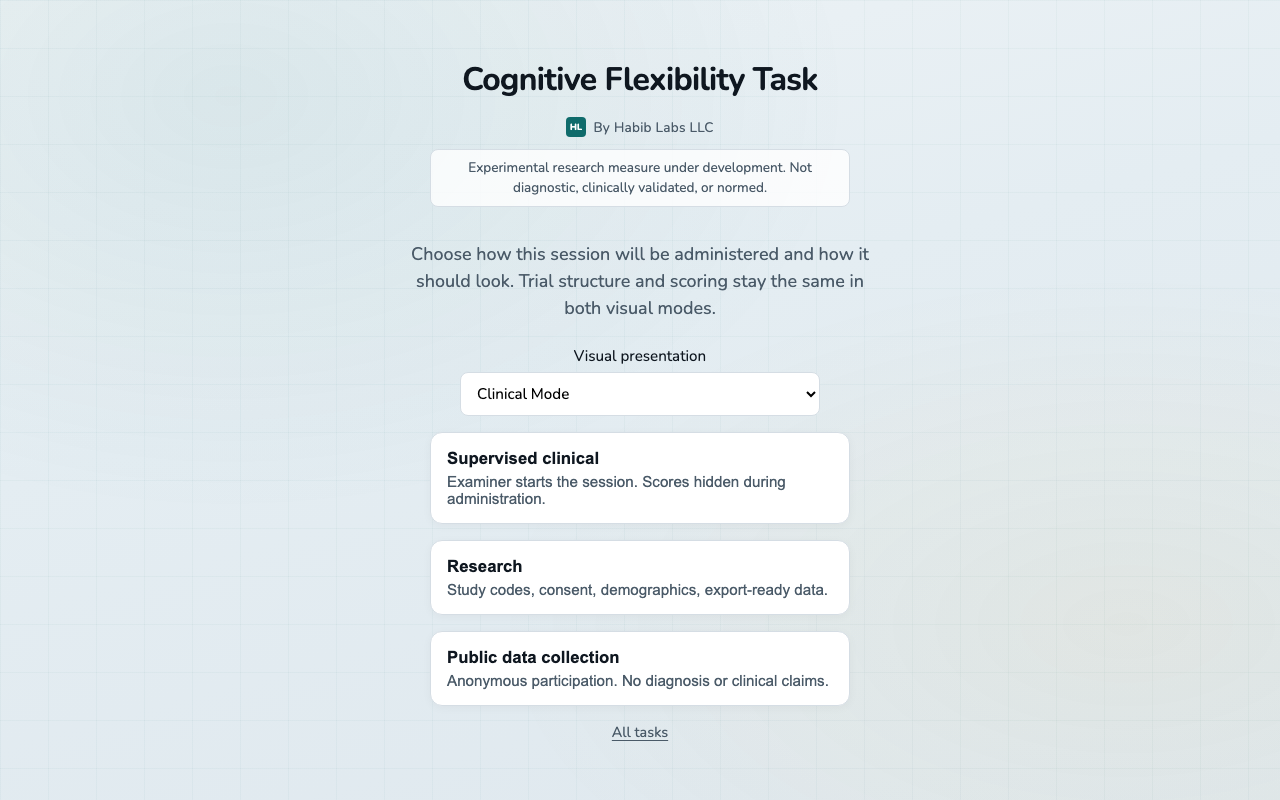
Functional research buildAssessment hub: Habib Labs branding and task entryOpen full sizeFunctional research buildFull battery administration path for the initial three tasksOpen full sizeFunctional research buildDemo mode: short versions of every taskOpen full sizeFunctional research buildGrid Memory Task introductionOpen full sizeFunctional research buildGMT stimulus: encoding symbols on a 4×4 gridOpen full sizePlanned interface conceptResponse Inhibition: mode selection (research pathway; clinician/public modes are roadmap items)Open full sizeFunctional research buildRIT stimulus: Signal Gate go / no-go cuesOpen full sizePlanned interface conceptCognitive Flexibility: mode selection (research pathway; clinician/public modes are roadmap items)Open full sizeFunctional research buildCFT stimulus: multi-feature object with rule cueOpen full size
FAQ
Questions
Is this battery diagnostic?
No. Current instruments are experimental research measures. They are not diagnostic, clinically validated, or normed.
Who can use it today?
Primarily research and development contexts. You can open the live experimental battery online. Clinician and public modes are part of the roadmap, not finished clinical products.
How does this relate to Attentis?
EF assessment informs Attentis-related measurement architecture but remains a distinct experimental executive function platform.
Open EF Assessment
Launch the live app in a new tab. Product beta interest remains available if you want updates or a waitlist spot.