← All products
Coming SoonFor complementary digital assessment tools under development

Attentis

Attentis is a planned offline attention and inhibition research platform. It is listed as Coming Soon while architecture and research pathways mature. Designed to complement comprehensive clinical evaluation, never replace it.

Every Habib Labs product is created research-first, with an evidence-based approach.

Attentis interface

ADHD evaluation needs structured performance data, not shortcuts

Clinicians often need organized performance metrics and multi-domain coverage that can sit alongside interviews and rating scales, without tools that overclaim diagnostic authority.

A research-oriented Attentis ecosystem (planned)

Attentis is being designed for multi-domain attention testing, behavioral measures, executive functioning measures, continuous performance tasks, clinician-facing organization, and research architecture. It always sits as a complement to professional evaluation. It is not released and is not a validated clinical product. Coming Soon reflects deliberate sequencing behind NeuroOS and EF Assessment.

Assessments & stimuli

Attention and response inhibition (performance metrics)

DCAIT-1 (Dual-Condition Attention and Inhibition Task)

The first research instrument in the Attentis stack. Brief shape stimuli appear with an internal feature (dot or vertical line). Depending on condition, participants respond to a critical target (vigilance) or withhold on that target (inhibition). Trial-level timing and accuracy support objective review. Never automated diagnosis.

Stimulus examples

  • Shape set. Circle, square, triangle, or diamond outlines. Culturally light geometric forms.
  • Internal feature. Each shape carries either a centered dot or a centered vertical line so targets are not color-only.
  • Critical target (default). Default critical stimulus is diamond with centered dot (diamond_dot). Other catalog items serve as distractors.
  • Condition contrast. Vigilance: respond to the critical stimulus. Inhibition: withhold on the critical stimulus and respond to others. Additional blocks extend the dual-condition design under research protocols.
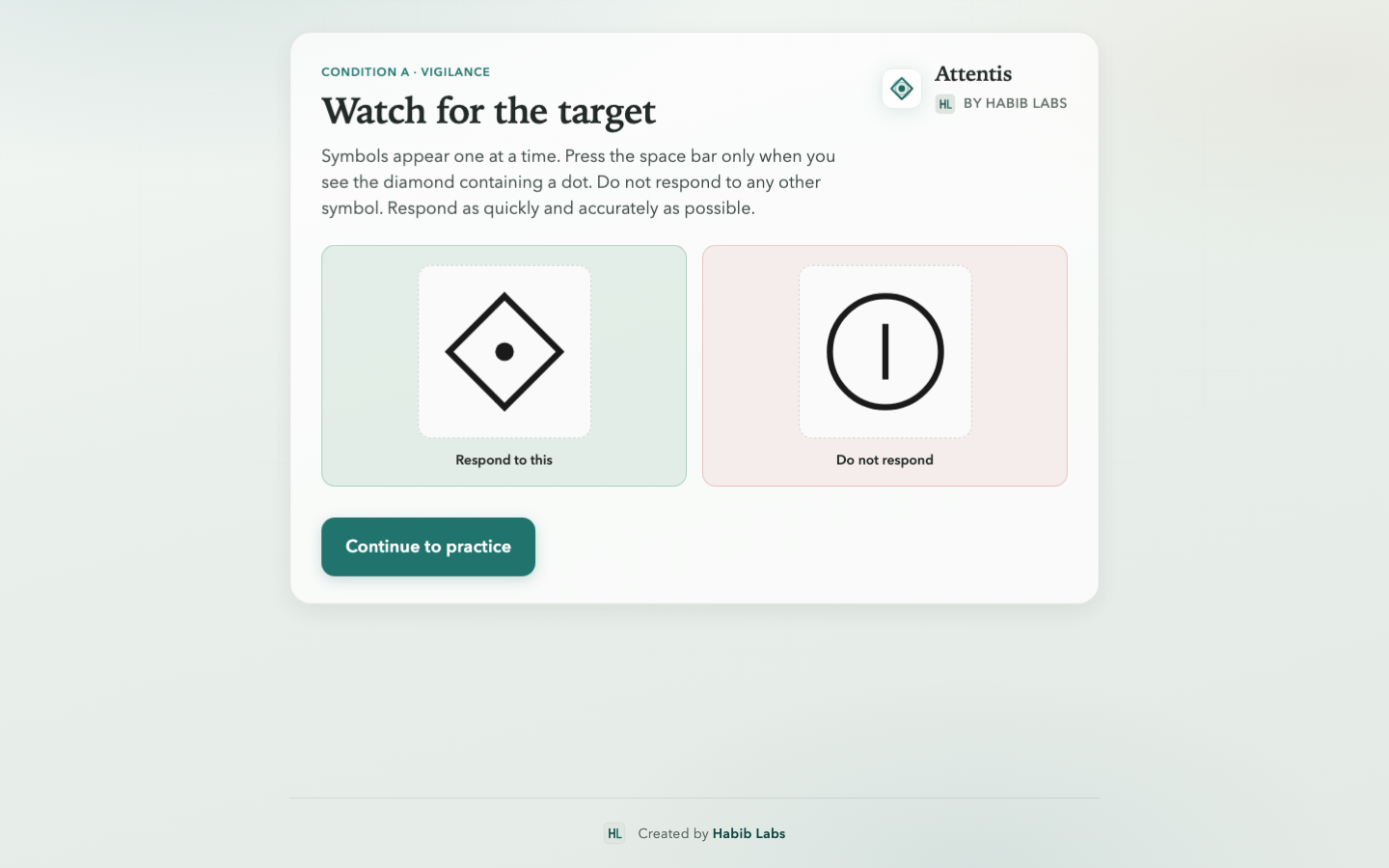
DCAIT-1 vigilance instructions with target and non-target stimulus examples
DCAIT-1 stimulus examples: diamond+dot target vs circle+line non-target

Experimental / pilot performance task. Complements clinical evaluation; does not diagnose ADHD.

How it works

  1. 1

    Multi-domain attention testing

    Structured attention measures across relevant domains.

  2. 2

    Behavioral measures

    Capture complementary behavioral indicators alongside performance tasks.

  3. 3

    Executive functioning measures

    Integrate EF constructs relevant to ADHD evaluation contexts.

  4. 4

    Continuous performance tasks

    CPT-style performance metrics for objective observation.

  5. 5

    Clinician dashboard

    Organize results for clinician review. Not automated diagnosis.

  6. 6

    Research-oriented architecture

    Data structures intended for studies and eventual validation work.

Capabilities

  • Objective performance metrics

    Structured scores and trial-level data for review.

  • Complements clinical evaluation

    Never positioned as a standalone diagnostic replacement.

  • Research pathways

    Built for eventual validation and collaboration.

  • Clinician-facing organization

    Dashboard intent for professional interpretation.

Where this is going

Now

Core task architecture

Stabilize attention and related task modules.

Next

Clinician dashboard

Organize metrics for professional review.

Later

Validation studies

Evidence before clinical claims.

Interface

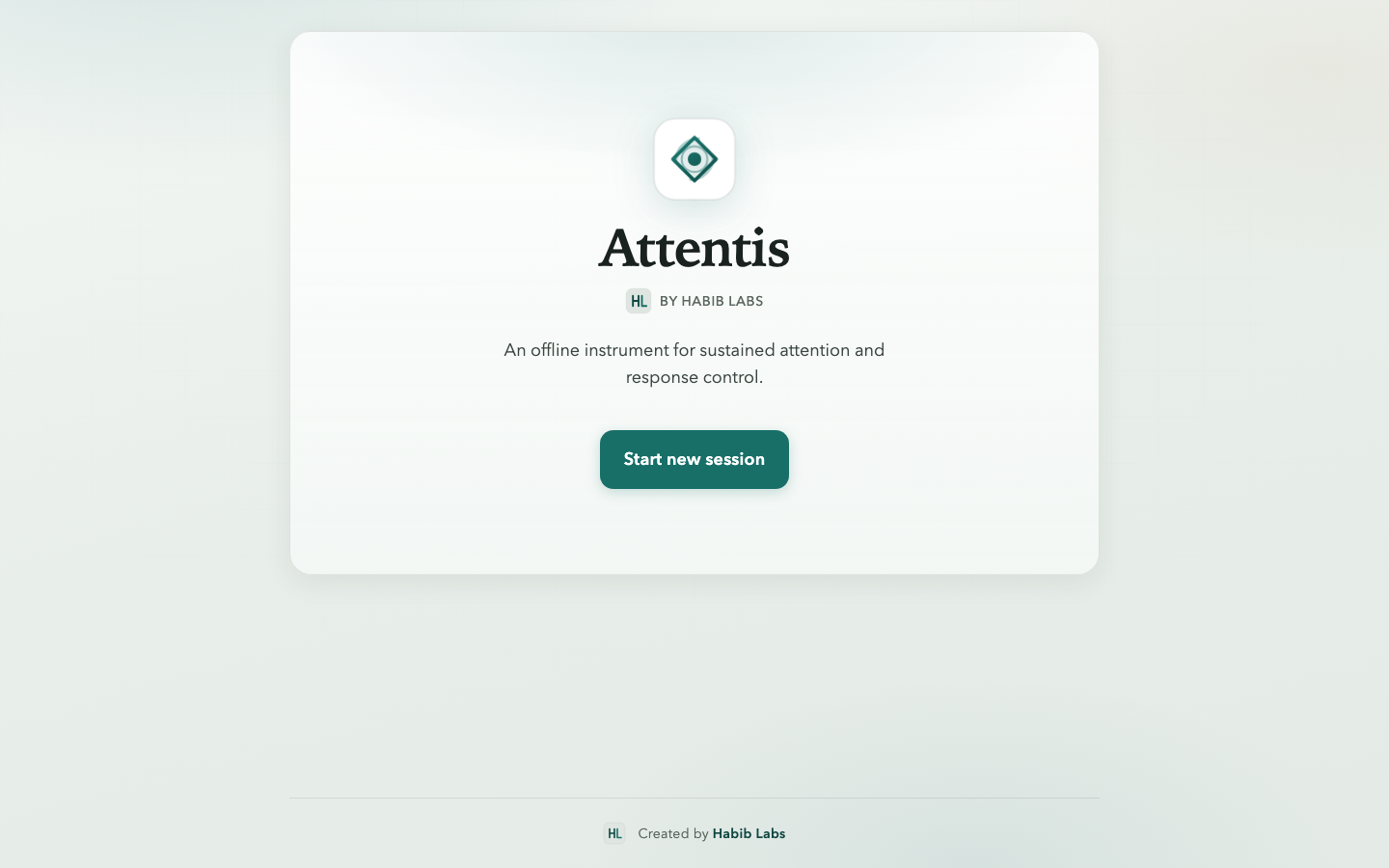
Attentis landing screen
Implemented prototypeAttentis: offline attention and inhibition research instrument (DCAIT-1 protocol)Open full size
DCAIT-1 stimulus examples for vigilance condition
Functional research buildDCAIT-1 stimulus examples. Respond to diamond+dot; withhold on other symbolsOpen full size

Questions

Does this diagnose ADHD?
No. It is designed to complement comprehensive clinical evaluation, not replace it. It is not a diagnostic product.
When will it be available?
Coming Soon is intentional: Habib Labs is sequencing Attentis behind active NeuroOS and EF Assessment work so architecture and research pathways mature before wider access. Join the waitlist for updates.

Join Attentis waitlist

Product beta interest is separate from research participation. Submitting interest does not enroll you in a study.